Adapting the Grid: User Experience Designing Services Toranto Predicting and Converting User Behavior through Smart UI

With every day of AI advancement, the interaction of businesses with users is getting modified significantly. Now, smart and adaptive UI/UX (User Interface/User Experience) designs are being promoted by agencies like Promodo that emphasize AI-first performance optimization. Modern UI Design & Interface Development Services are leaving behind the rigid static layouts in favor of intelligent interfaces. As a result, the users are not being forced to adjust to the rigid patterns. Instead, the designs themselves transform according to the underlying patterns and intentions of the users. From high intent purchasing to casual research, the UI/UX designs will modify accordingly.

The Architecture of the Fluid Grid
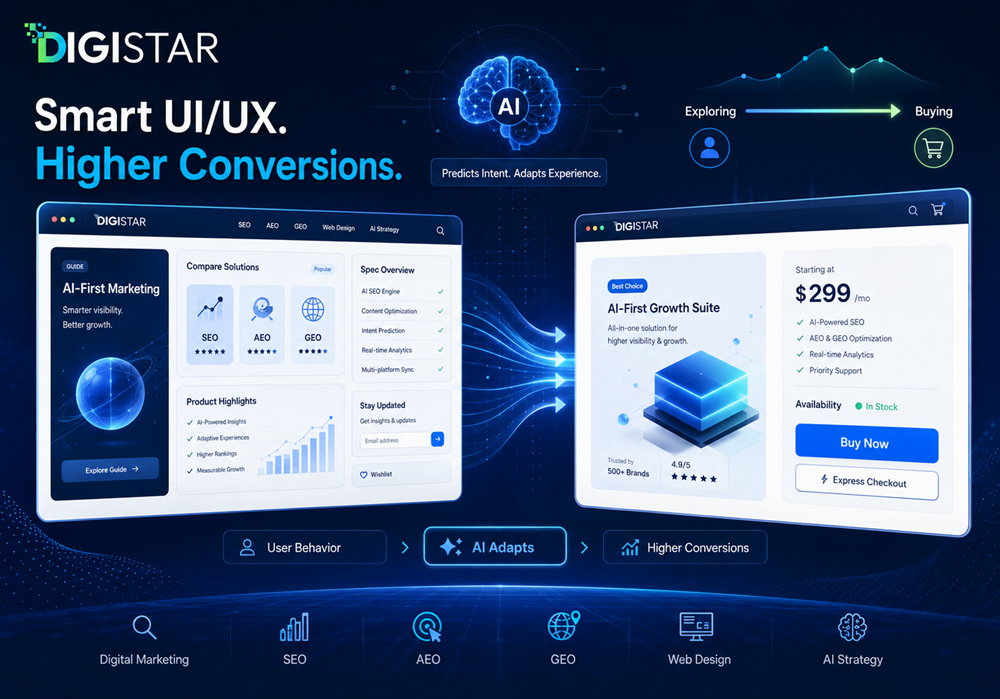
- For a casual user, the interface will be multicolumnar, suitable for exploration. While for serious high intent users, the UI would be made single columnar and frictionless for high conversion.
- UI Design & Interface Development Services use multi-banner screens for storytelling and value propositions for casual researchers. While for high intent purchasing habits, they place direct, target-driven CTAs (Call-to-Actions) and lucrative deals at the forefront.
- Micro-commitment forms (e.g., "Save to Wishlist," newsletter opt-ins) are used for casual researchers. On the other hand, for high intent purchasers, direct transactional forms (e.g., Express Checkout, one-click buying) are used more frequently.
- Another distinction between casual researchers and high intent purchasers is that, for the former, deep comparative charts, extensive specs, and community reviews are provided. While for the latter, simplified pricing, immediate availability, and urgency triggers are widely used.
Behavioral Prediction to Conversion
User Experience Designing Services Toranto are widely using predictive behavioral models. This is helping them distinguish between the casual researchers and the high intent buyers:
- A casual researcher would have usage patterns involving backtracking pages, opening multiple tabs, lingering on informational sections, and so on. When the smart UI detects such patterns, expands the layout to display educational blocks, side-by-side comparison tables, and low-friction micro-commitment forms. This not only builds trust among users, but also gathers email data without driving a premature sale that might cause user abandonment.
- A high intent buyer will have patterns like high-speed targeted navigation, specific filter usage, and immediate movement toward purchasing options. Detecting such navigation patterns, the smart UI hides secondary site banners, strips away informational noise, and shuffles checkout components right to the focal point of the screen to minimize friction.
This adaptive UI/UX is significantly enhancing user experience and benefiting enterprises by reducing purchase friction and giving customers the ease they desire.
FAQ:
What is adaptive UI/UX design, and how does it improve user experience?
Now, smart and adaptive UI/UX (User Interface/User Experience) designs are being promoted by agencies like Promodo that emphasize AI-first performance optimization. Modern UI Design & Interface Development Services are leaving behind the rigid static layouts in favor of intelligent interfaces. As a result, the users are not being forced to adjust to the rigid patterns. Instead, the designs themselves transform according to the underlying patterns and intentions of the users. From high intent purchasing to casual research, the UI/UX designs will modify accordingly.
How does AI-powered UI/UX design predict user behavior and increase conversions?
A high intent buyer will have patterns like high-speed targeted navigation, specific filter usage, and immediate movement toward purchasing options. for serious high intent users, the UI would be made single columnar and frictionless for high conversion. For high intent purchasing habits, they place direct, target-driven CTAs (Call-to-Actions) and lucrative deals at the forefront. For high intent purchasers, direct transactional forms (e.g., Express Checkout, one-click buying) are used more frequently. Simplified pricing, immediate availability, and urgency triggers are widely used as well.
How do smart interfaces adapt to casual researchers and high-intent buyers?
For a casual user, the interface will be multicolumnar, suitable for exploration. While for serious high intent users, the UI would be made single columnar and frictionless for high conversion. UI Design & Interface Development Services use multi-banner screens for storytelling and value propositions for casual researchers. While for high intent purchasing habits, they place direct, target-driven CTAs (Call-to-Actions) and lucrative deals at the forefront. Micro-commitment forms (e.g., "Save to Wishlist," newsletter opt-ins) are used for casual researchers. On the other hand, for high intent purchasers, direct transactional forms (e.g., Express Checkout, one-click buying) are used more frequently. Another distinction between casual researchers and high intent purchasers is that, for the former, deep comparative charts, extensive specs, and community reviews are provided. While for the latter, simplified pricing, immediate availability, and urgency triggers are widely used.
What UI/UX design strategies help convert high-intent visitors into customers?
for serious high intent users, the UI would be made single columnar and frictionless for high conversion. For high intent purchasing habits, they place direct, target-driven CTAs (Call-to-Actions) and lucrative deals at the forefront. For high intent purchasers, direct transactional forms (e.g., Express Checkout, one-click buying) are used more frequently. Simplified pricing, immediate availability, and urgency triggers are widely used as well.
How can UI Design & Interface Development Services reduce friction and improve conversion rates?
A high intent buyer will have patterns like high-speed targeted navigation, specific filter usage, and immediate movement toward purchasing options. Detecting such navigation patterns, the smart UI hides secondary site banners, strips away informational noise, and shuffles checkout components right to the focal point of the screen to minimize friction. This will reduce friction and improve conversion rates.
Similar Blogs

From Seats to Outcomes: How AI is Changing SaaS Pricing with SaaS software development company Alberta
Nov. 19, 2026
TD Bank Invests in AI Skill Building: Beginning A New Canadian Digital Trend for a Better Future
Nov. 16, 2026